
She/Her/Hers
Lesbian
|
|
EMILY PRATT SLATIN | About | Press Kit | Notebook | Music Playlist | She/Her/Hers Lesbian |
Retired Career Fire and EMS Lieutenant-Specialist, Writer, and Master Photographer, living in Vermont.
Fall, 2026
Stamford, New York
I'm forty-seven years old, and somehow I've managed to become sixteen again. Perhaps I'll be sixteen for good.
When I was growing up in the 1980s, I was taught that the life of a typical American girl was supposed to follow a fairly predictable sequence of events. Go to school, graduate from college, establish a career, get married, have children, raise those children, continue working until retirement, and eventually grow old enough to spend whatever remained of my life doing all the things I was supposedly working toward in the first place.
I didn't do any of those things the way I was expected to.
I married Amelia, the woman I loved, and we eventually established an arrangement in which we remain married while living separate lives. I helped raise a daughter who was neither biologically nor legally mine, but who recently began to introduce me to her friends as her mother.
Somewhere along the way, I became a successful, published author, fulfilling one of my childhood dreams. I've now written three volumes of a diary documenting a life that would probably have caused considerable concern among the adults responsible for determining whether I was developing into a socially acceptable child.
They would have been disappointed. I never did become particularly socially acceptable.
I was always different. So different. For most of my life, that difference made it difficult to be part of anything. Even when I was included, I often found myself excluded from the activities that supposedly made me a member of the group.
I attended summer camp for years, eventually returning to work there, yet I never managed to maintain the lifelong friendships I thought would naturally result from spending so many summers with the same people. I attended boarding school, where institutional acceptance and genuine human affection were entirely different things. I eventually ran away, only to find my way into emergency services, where my professional abilities were appreciated, but my personal life remained something that most people either misunderstood or chose not to acknowledge.
I spent years being useful to other people. I was exceptionally good at it. If something went wrong, I was often the person expected to know what to do next.
Yet professional competence never guaranteed social acceptance. I could be entrusted with someone's life in an emergency and somehow still be excluded from an ordinary gathering afterward. I never fully understood that.
For years, I wondered whether I was too different, too independent, too intense, too queer, too autistic, or simply too much of whatever made me who I was. What I wanted was straightforward. I wanted lifelong friendships with people who genuinely cared about me. At forty-seven, I finally have them.
Amelia has done so many amazing things for me, but perhaps the best thing she ever did for me was to hand me my freedom in a golden box.
Amelia and I are still married. We simply live separate lives now, with our own homes, schedules, and the freedom to make independent decisions without organizing every aspect of our lives around maintaining a conventional domestic relationship.
The change was not something I initially wanted. I married Amelia because I loved her, because she was my best friend, and because I genuinely wanted to spend my life with her. When she first told me she wanted to separate, I was devastated. I would have preferred that our life continue exactly as it had been.
My circumstances changed, I learned to accept and adapt, and gradually I began rediscovering a degree of personal freedom I hadn't experienced since adolescence. I remain grateful for my marriage to Amelia. We had experiences together that I never would have had without her, and none of those memories became less meaningful when our living arrangements changed. I still love her, and she remains an important part of my life.
I'm also discovering that I thoroughly enjoy living independently. I no longer work in emergency services. There are no shifts to cover, no dispatchers calling me at two in the morning, no supervisors wondering why I haven't completed paperwork, and no obligations requiring me to arrange my social life around an unpredictable work schedule.
I can go somewhere simply because I feel like going there. I can spend an afternoon with a friend, stay out late, drive somewhere interesting, listen to music, write, take photographs, or spend several hours doing absolutely nothing productive. For someone who spent decades working in emergency services, this is an extraordinary concept.
I've surrounded myself with younger friends, or people who still have young hearts, who genuinely love and care for me. They invite me into their lives, remember details about me, and accept the peculiarities that have accompanied me for the better part of forty-seven years. I am fully accepted for the first time in my life. I still find that remarkable.
Recently, I've been spending considerable time in Stamford, where I grew up. Mom died last year, and Amelia and I inherited her house. I've been restoring the property, making repairs, and gradually bringing the place back to the condition it deserves after decades of deferred maintenance.
My childhood bedroom is still upstairs, exactly where it was when my parents moved us here in 1986. It's also still a mess. Apparently, thirty-one years of adulthood have done remarkably little to improve my housekeeping habits.
Yesterday morning, Nora sent me a text saying that she and her mom were on their way home from Tops in Stamford. She also let me know that her mother said hello. I replied, “Let her know I also said hello—and that I would have been more articulate if it wasn't for the early hour.”
Nora asked if I could help move some furniture in her bedroom after she had finished painting. Her mom had offered sandwiches for lunch. I said sure, I'd be right up after I ate my pizza.
My pizza burned in Mom's oven. I asked whether the offer for sandwiches was still good and, if so, I'd be right up.
Yesterday was also my friend Rene's birthday, and there was karaoke at the Belvedere. Nora and I spent much of the afternoon and evening together, eventually going to John's Tavern after the Bel closed.
The first song performed at karaoke was Mazzy Star's Fade Into You. I found this particularly appropriate, given that I seem to have returned to the 1990s without the inconvenience of having to attend school or explain my whereabouts to my father. The Belvedere, which everyone simply calls the Bel, has become one of my favorite places in Stamford. It reminds me of summer camp, although the building itself has the institutional appearance of my old boarding school.
At the Bel, I can spend time with friends, sit outside by the fire, and listen to music. Because Mom's house is at the opposite corner of the block, I can leave whenever I feel like it.
Unfortunately, the building itself is falling apart structurally. Nora and I have become increasingly concerned that the Belvedere might not be around much longer. We both feel that it has reached a now-or-never situation, and the possibility that it could disappear concerns me. The Belvedere is the last remaining grand hotel in Stamford. There was a time when the town had several enormous hotels and resorts that attracted visitors from all over the world. I've watched them disappear one by one, during my lifetime.
One of the places I remember most clearly was the Red Carpet Motor Inn, an enormous hotel and resort located at the intersection of New York State Routes 10 and 23. The Red Carpet had everything. There was a swimming pool, shuffleboard, golf, a restaurant, and an almost unreasonable amount of wall-to-wall red carpeting that looked almost exactly like the upholstery inside an average American sedan manufactured sometime during the 1980s.
The place occupied a prominent location in town, and its enormous sign became part of the local geography simply because it had been there for as long as anyone could remember. I remember when it closed. I was in college at the time. A developer had purchased the property and announced that everything needed to be cleaned out before the buildings were removed. Anything left behind would have to be disposed of.
People started going to the restaurant for dinner during the last remaining days. They would arrive for one last meal and leave carrying various accouterments bearing the Red Carpet's logo. I wonder how many of those objects are still sitting in kitchen cabinets around Stamford. Somewhere, there may be a coffee cup, an ashtray, or a piece of restaurant china bearing the logo of a resort that disappeared decades ago.
There's now a Stewart's gas station on the corner where the Red Carpet sign once stood. Eventually, the Red Carpet was demolished, and the property was redeveloped into a Walgreens drugstore. That Walgreens recently closed. The hotel lasted for years, the drugstore came and went, and the intersection continues to accommodate non-stop traffic as though nothing particularly important happened there.
Every empire crumbles to dust. I've watched buildings disappear, businesses close, and familiar places become empty lots or newer establishments bearing little resemblance to what stood there before. In 1998, when I was home for Christmas break from college, the boarding house next door to my parents' house caught fire and burned to the ground. I convinced my parents to purchase the property, which they did. Eventually, they sold approximately one-third of the lot to the neighboring property behind Mom's house on Academy Street.
Ginny and Butch lived there. Butch was retired FDNY, and Ginny liked spending time at John's Tavern. Those two were my favorite neighbors. They have since both died, and now a married lesbian couple lives in their house.
I still go to John's. Aside from the decorations hanging on the walls, John's has never changed during my lifetime. They've added two Trump flags, which I don't appreciate, but otherwise the place remains exactly as I remember it. It remains somewhere people gather, talk, drink, and occasionally become involved in discussions that would probably benefit from considerably less alcohol and a more comprehensive understanding of the subject being discussed.
Yesterday evening, after the Bel closed, Nora and I went to John's for a short time. The place was so packed that opening the front door required a certain amount of social etiquette and cooperation from everyone standing nearby. The people have changed. Some have grown older, others have died, and younger generations now occupy the same tables and barstools.
But John's is still John's.
My old summer camp, however, is also crumbling. I spent years believing that summer camp was one of the most important places in my life. I loved the woods, the pine trees, the freedom to wander, and the opportunity to be away from the circumstances that made my childhood so difficult.
I was never particularly successful at fitting in with the other children, but I loved the property itself. I could spend hours in the woods, building forts out of fallen trees and following trails, completely content with my own company. Being alone in the forest was considerably more enjoyable than attending organized activities where nobody seemed particularly interested in including me.
Years later, I returned to work there, eventually leaving under circumstances that were far less pleasant than the summers I remembered. My attempts to remain connected with the camp afterward were equally disappointing.
Now the camp property is deteriorating, and its future is uncertain. I suppose there is some irony in the fact that my actual summer camp and the Belvedere, my adult version of summer camp, are both deteriorating at the same time. The buildings are getting older while I'm somehow becoming younger. It feels like an alternative version of my childhood, where everything is suddenly different.
I don't know whether either place will survive another thirty years. I would like them to, particularly the Belvedere, which continues to be part of the life I'm enjoying now. Last night, I was sitting alone beside the fire at the Bel for a short time when I heard a single truck traveling through Stamford on Main Street, heading toward Grand Gorge.
I heard it approaching, then passing through town. Eventually, the sound grew quieter until it faded away into the distance. I sat there listening. I remember being a child in Stamford and hearing vehicles traveling through town late at night. Trucks, tires on pavement, engines, and the occasional car passing through after everything else had become quiet were part of the familiar atmosphere.
For a few minutes, there was nowhere I needed to be, nothing I needed to do, and nobody expecting me to accomplish anything. I was sitting beside a fire at a place I enjoyed, surrounded by the familiar geography of a town I had known since childhood. And I was happy.
I spent much of my life believing happiness would eventually arrive after I accomplished enough things. Education was supposed to lead to a career, a career to financial stability, and financial stability to a successful adult life. Somewhere within that process, I was expected to become happy.
I had a career. I was respected professionally. I owned multiple properties, accumulated possessions, and achieved many of the things I once believed would make my life complete. And yet, for much of that time, I was miserable.
Recently, the bank called me in for another meeting about my financial allocation. I found myself sitting across from a man I had never met, who was seated behind a large wooden desk. He was writing things down on paper and discussing possible outcomes, all of which seemed to involve risks I had already identified as unacceptable. He asked if I would still listen to what he was proposing.
At work, risk was part of every emergency, every rescue, and every decision made under circumstances where the available information was incomplete and the consequences of a mistake could be permanent. I accepted those responsibilities because they were part of my job. Now I'm retired, and I have absolutely no intention of voluntarily introducing unnecessary uncertainty into a life I finally enjoy.
They had graciously provided me with a total of fifteen orange lollipops in a glass bowl from the local discount store. I was willing to at least listen to what they had to say.
I understand perfectly well that nothing in life is guaranteed. People change, relationships change, businesses close, buildings deteriorate, and the future has a remarkable ability to disregard whatever arrangements human beings make in anticipation of its arrival. After a lifetime of chances, I demand guarantees.
The banker continued discussing possibilities. He simply wasn't listening to me. I told him stories all afternoon instead of discussing my financial allocation.
Yesterday evening, after spending much of the day with Nora, listening to karaoke, celebrating Rene's birthday, and going to John's, I returned to Mom's house a little after midnight.
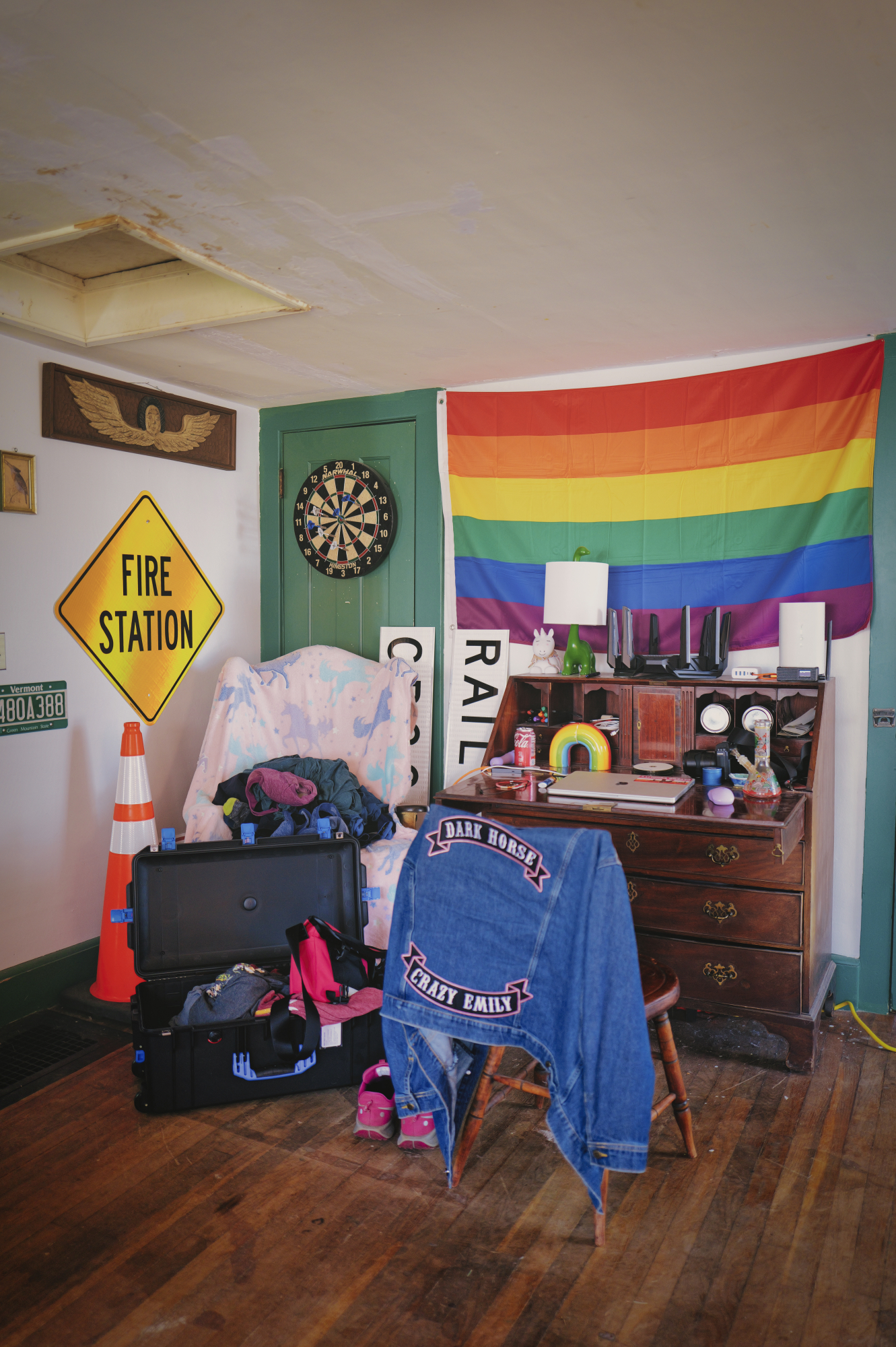
I walked upstairs to my bedroom, took off all my clothes, and left them in a heap on the floor. It's still a mess, just as it was thirty years ago. The funny thing is that I haven't changed very much. I'm still the same curious, unconventional, occasionally reckless woman who loves pine trees, music, old buildings, trains, photography, writing, and spending time with the people who matter most to her.
I still spend an unreasonable amount of time thinking about buildings that no longer exist, roads that have changed, people who have disappeared, and objects that somebody probably should have thrown away twenty years ago. And I still have absolutely no intention of becoming the sort of responsible adult my father once expected me to be.
I was born with a wild heart, forbidden to fly. In time I learned to say goodbye. In the end, only my friends loved me the same way Mom loved me. And friendship became the love I never knew.
|
Copyright © 1998-2026 Emily Pratt Slatin. All Rights Reserved. About | Archives | Biography | EMD Codes | Notebook | Press Kit | Pronouns.page | RSS Feed | Sitemap | YouTube Made with grit in Middletown Springs, Vermont. |