
She/Her/Hers
Lesbian
|
|
EMILY PRATT SLATIN | About | Press Kit | Notebook | Music Playlist | She/Her/Hers Lesbian |
Retired Career Fire and EMS Lieutenant-Specialist, Writer, and Master Photographer, living in Vermont.
May 10, 2026—Middletown Springs, Vermont (Home)
Last night was the first time in years that I actually had a dream. That feels strange to write. Most people dream regularly, or at least remember enough of the fragments to say they did. Last night was different.
In the dream, I was homeless again, living in my car the way I did when I was younger. But the part that stayed with me after I woke up was not the homelessness itself. It was the fact that, in the dream, it did not bother me. It was simply understood. I was living in my car. That was the condition of things.
The younger version of me knew what that actually meant. She knew the cold. She knew the logistics. She knew how to make a vehicle function as shelter, bedroom, storage unit, hiding place, escape route, and proof of life. But dream-me was not afraid. That is what unsettled me.
Some part of my mind revisited one of the hardest arrangements of my early life and treated it like familiar terrain. Not danger. Not emergency. Just something already known.
I woke up thinking about summer camp.
That makes sense to me, though I doubt it would make sense to anyone else. The dream was about homelessness, but the feeling after it was about being unheld. There is a difference, though the body does not always bother separating them. A person can have shelter and still feel socially homeless. A person can be remembered and still not be included. A person can be called a friend by people who have never known a single meaningful thing about her life.
For decades, I was told to believe this was friendship. Mostly by my parents. Especially Mom, who possessed a gift I never inherited—the ability to call someone a friend even when there had been no contact for decades, then revive the connection instantly if that person appeared again later in life. To her, friendship could go dormant for decades and remain intact. It was a book placed on a shelf, waiting to be opened again.
I understood friendship as continuity. Not constant contact, not performance, not obligation dressed up as affection—but some kind of ongoing witness. Some kind of mutual awareness that the other person is still living, changing, surviving, becoming.
I do not need someone to speak to me every single day to believe they matter. But decades of silence do not feel like friendship to me. They feel like memory wearing the wrong name.
Summer camp was supposed to be one of those lifelong things. Or at least that was the story. We were all told it mattered, that the bonds formed there were special, that we would always be connected by those summers, by the lake, by the cabins, by the campfires, by the smell of pine needles, sunscreen, wet towels, lake water, and woodsmoke that still lives somewhere in the back of my nervous system.
The last real summer was 1998. After that, everyone left. By 2000, everyone I knew had left.
Not all at once, and not with any cruelty I can point to. That would have been easier. There was no final argument, no dramatic betrayal, no closing scene where someone defined the ending for me. Everyone simply continued living, and I was no longer inside the structure of what continued.
For years, I watched the people I called friends live their lives. They got married. They had children. They bought houses, built careers, took vacations, and moved through adulthood in visible, connected ways. Occasionally, a collection of photographs would appear online—a beach, a dinner table, a wedding, a vacation house somewhere—and there would be a handful of people I knew from the same camp standing together, smiling with the ease of people who had remained threaded through one another's lives. I was never included.
Camp reunions came around every several years. I attended most of them. I showed up the way I always show up—willing, observant, hopeful, still carrying the strange idea that shared history might eventually become present-tense belonging.
There were hugs. Conversations. Old stories. The temporary warmth that appears when people agree, for a few hours, to remember the same version of the past. There were promises too. We will keep in touch. We will meet up. We will make plans soon so that we won't let so much time pass. Then everyone went home, and nothing happened. The same story repeated itself.
For a while, Facebook created the illusion that the connections still existed. We were all technically linked, all visible at the edges of one another's lives. It was not friendship, exactly, but it was atmospheric proof. They were still somewhere. I was still somewhere. A thin wire remained strung between the past and the present, and even though no current moved through it, I mistook its existence for continuity.
Then came the day I closed my Facebook account, and the last connection was severed. For months I had posted my contact information on my Facebook page, citing social media as contributing to the worsening of my mental health. No one came looking. That was confirmation of my fear.
I do not blame them for living their lives. People are allowed to continue. They are allowed to marry, have children, go on vacations, build circles, and keep company with those who remained close enough to become permanent.
What I object to is social shunning framed under the categorization of friendship. The assumption that fond memory and friendship are the same thing. The expectation that a person can be absent from every meaningful chapter of your adult life and still occupy the same relational category as someone who stayed.
They missed everything. They never knew my career. They never knew what it cost me to become a Paramedic and Firefighter. They never knew my first house. They never knew the nearly twenty years I spent with Angie, the way that relationship shaped my adult life, the way it ended, returned, shifted, fractured again, and left behind a record too complicated for anyone outside it to summarize cleanly.
They never knew the alcoholism. They never knew the mental health struggles. They never knew the nights when I was not sure I would make it through the next day, never mind the next year. They never knew what it meant for me to retire at forty, to walk away from work that had raised me, sharpened me, injured me, and nearly consumed whatever softness I had managed to keep alive.
They never knew of Amelia. They never saw the farm. They never saw the life I built after the life they remembered became obsolete. They never saw me become the woman I am now. And I wanted them to know.
I wanted them to see the broken parts of me. Not because I wanted pity, and not because I needed rescue. I wanted witness. I wanted someone from that earlier world to look at the full arc of my life and understand that I continued after they left the frame.
I wanted them to know that the girl they remembered had not remained suspended forever in some Adirondack summer, sunburned and awkward and quietly in love with girls she did not yet know how to claim out loud.
I wanted them to know because, over the years, I was there for their struggles.
Every couple of years, someone from my past would find my number and call me. The pattern became almost procedural. Something had gone wrong—a breakup, a crisis, grief, fear, some internal fracture they needed to say aloud to someone who would listen. And I would answer. Of course I would. I have always been the person who answers. I would listen, advise, explain, hold the line, offer the kind of calm I learned to produce under much worse conditions.
Then that would literally be the last time I ever heard from them. Crisis, contact, advice, silence. Repeat often enough, and even affection starts to feel extractive. That is not friendship. That is response work. I have already done enough response work for one lifetime.
And then there was Allegra.
I cannot write honestly about camp without writing her name. I was once in love with a girl from camp named Allegra. Madly in love with her, in the way first love is always mad because it has not yet learned proportion. She was my first love, and some part of me probably always will be in love with her—not in a practical way, not in a way that asks anything from the present, but in the way first love becomes a fixed coordinate.
There are people who do not remain in your life, yet never fully leave your internal geography. Allegra was that for me.
I do not know what I meant to her. Maybe very little. Maybe something ordinary. Maybe a passing summer closeness remembered, if at all, with warmth and no particular ache attached. That is the imbalance of first love, especially queer first love.
Still, she mattered. She still matters, though not in the same way. She is part of that preserved world, part of the reason camp never became merely camp in my mind. It was not just cabins, lake water, schedules, and counselors with clipboards. It was longing. It was recognition. It was the first time my heart pointed toward another girl with such certainty that even fear could not fully obscure it.
For me, camp was never just a chapter. It was an origin point. For everyone else, maybe it was summer.
Another reunion is scheduled for the end of this summer. Before the email came, I told Amelia I would be shocked if I were invited at all. Invitations carry more meaning than people admit. They say, we thought of you while deciding who belongs here.
I do not know what I expect from going back, if I even go back at all. Maybe nothing. Maybe that is the healthiest answer. I am not twenty. I am not sixteen. I am not the girl living in her car, trying to pretend the situation was temporary enough to be survivable. I am not the young woman madly in love with Allegra, carrying an entire emotional universe in silence. I am not the camper enrolled under a name that was never mine, or the kitchen worker after exile, washing dishes because labor did not ask as many questions as people did.
I have lived enough life that anyone who only remembers me from camp does not know me at all. I still need the closure, regardless of how it ends. That is not their fault.
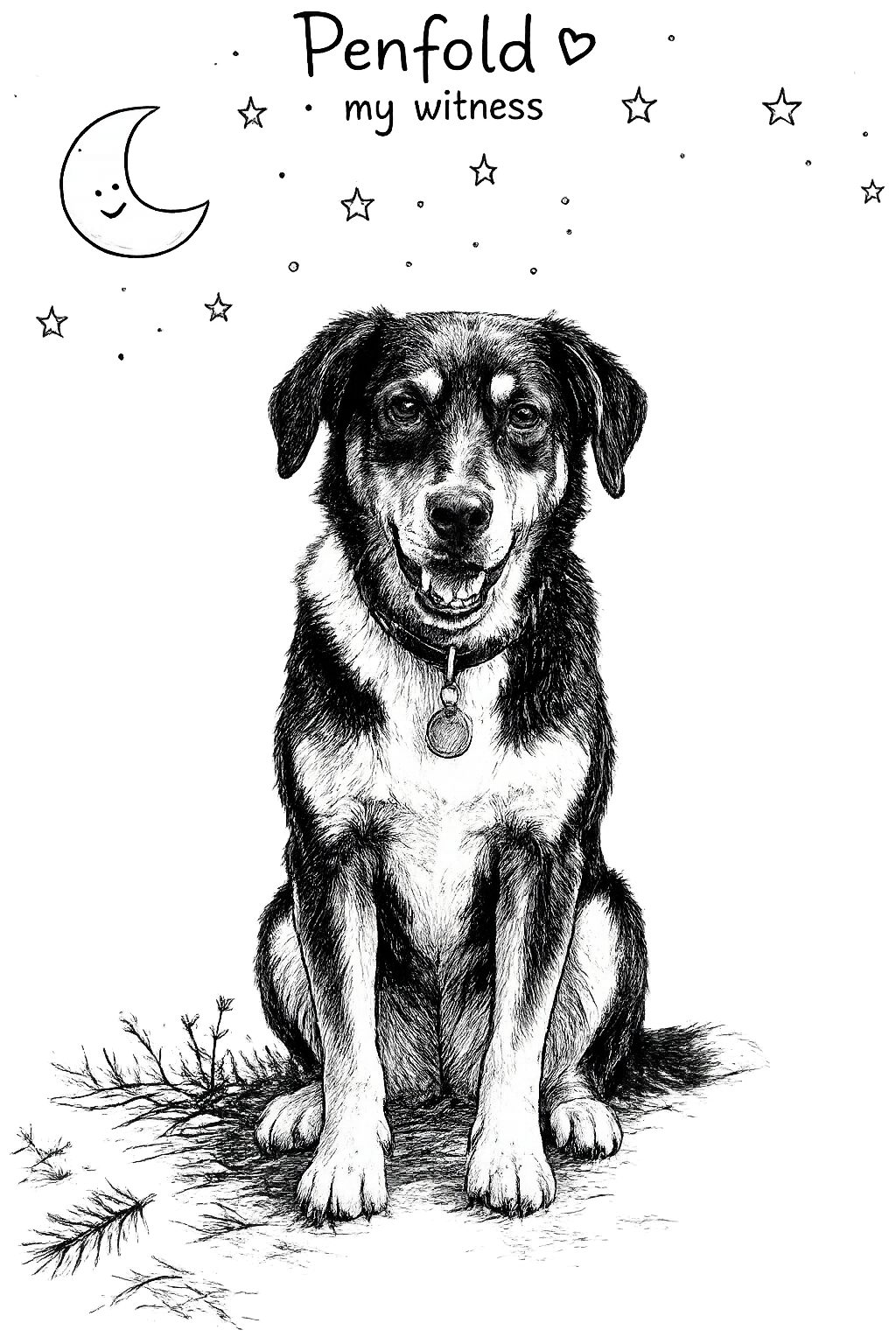
I grew up alone, and my witnesses became Penfold, the moon, and pine trees.
That sentence has been sitting in me all day. It may be the most accurate thing I know about my childhood. People came and went. Friends rotated in and out of eras. Family became conditional. Institutions renamed me, relocated me, corrected me, filed me incorrectly, and acted surprised when the paperwork failed to become biology.
But Penfold stayed. The moon returned. The pines stood where they were placed and refused to participate in anyone's revision of me.
Penfold was not just a dog. He was the one who knew who I truly was. The parts of me nobody acknowledged, and never talked about. He knew the girl under the blanket, the girl in the car, the girl in the tent, the girl trying to understand why the adults who were supposed to protect her kept making survival more complicated than it needed to be. He did not ask me to explain myself. He did not need the socially acceptable version. He simply came close, pressed his body against mine, and made the world less unbearable.
Then, one day when I got called into work last minute on my day off. Instead of Angie watching Penfold, he instead ended up at moms for the day, Dad forced Mom to have Penfold put down before his time. I went to work that morning, only to return the following morning and Penfold was dead. I have carried that regret ever since.
I have lived long enough, and worked enough scenes, to understand that life is not obligated to give anyone a gentle ending. But Penfold was taken from me before his natural arc was finished because my father made that decision, and my mother carried it out.
The most reliable witness of my childhood was removed, and once again I had to understand that even love could be overridden by someone else's authority. Dad did not just control narratives. He controlled endings.
I do not think I ever forgave him for that. I am not sure forgiveness is even the correct category. Some things are not awaiting repair. They are part of the record. Penfold deserved more time. I deserved more time with him. Mom deserved the courage not to be forced into carrying out my father's will in ways that harmed both of us. But that was our house. That was the structure. Dad decided. Mom absorbed. I adapted. Penfold paid the price.
I have always struggled with the way people use the word friend. To me, friendship is not nostalgia. It is not dormant affection. It is not a pleasant feeling reactivated at reunions. It is not the ability to say, "We should keep in touch," while already knowing no one will do the work required to make that sentence true.
Friendship is presence under changing conditions. Friendship is witness. Friendship is someone knowing the version of you that came after the old version survived.
By that standard, my friends now are Amelia and Maddie—the two greatest friends I have had in my entire life. Amelia knows the living person, not the preserved one. Maddie knows me almost as well as Amelia. They know my humor, my intensity, my silences, my shutdowns, my practical tenderness, my difficult standards, my ridiculous consistency, my intolerance for nonsense, and the way my heart stays loyal long after most people would have packed up and called it wisdom.
They have seen broken parts of me and did not turn that access into distance. That matters tremendously to me.
It took most of my life to find friendships that match the way I love. Not perfectly. Nothing human is perfect. But close enough that my nervous system recognizes the difference. To them, I am Emily.
That should not feel revolutionary. And yet, it does.
|
Copyright © 1998-2026 Emily Pratt Slatin. All Rights Reserved. About | Archives | Biography | EMD Codes | Notebook | Press Kit | Pronouns.page | RSS Feed | Sitemap | YouTube Made with grit in Middletown Springs, Vermont. |