
She/Her/Hers
Lesbian
|
|
EMILY PRATT SLATIN | About | Press Kit | Notebook | Music Playlist | She/Her/Hers Lesbian |
Retired Career Fire and EMS Lieutenant-Specialist, Writer, and Master Photographer, living in Vermont.
July 31, 2026—Middletown Springs, Vermont (Home)
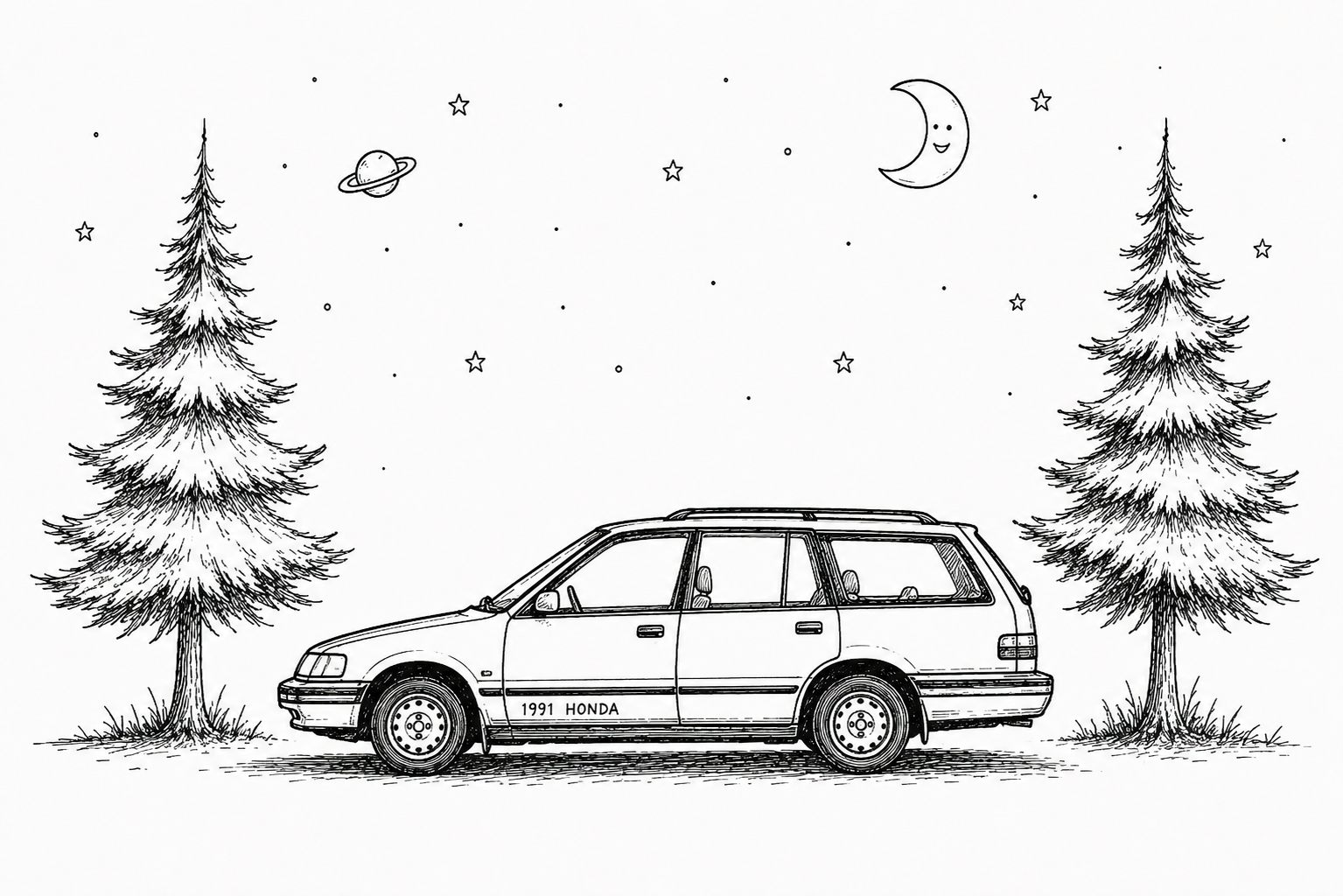
This morning, I found myself thinking about my blue 1991 Honda station wagon. For many years, that car was the center point of my life.
When I was a small child, Dad was mostly home on weekends. He worked at Fidelity Chemical in Newark, New Jersey, while the rest of us lived inside the ordinary rhythms of childhood. His absence was familiar enough that I did not initially understand it as absence. Mom was there all the time. Dad returned whenever he wasn’t commuting from our New York City apartment. The household appeared almost normal for the weekend, then fractured again.
Dad loved me when I was small. I know that for certain. He provided almost anything I wanted, often with the confidence of someone who believed material generosity could solve whatever emotional problem remained unnamed. If I became interested in photography, there was a camera. If I wanted books, there were books. I was a curious child. Dad provided me with an encyclopedia set, and an IBM PC Jr. If a school promised opportunity, he paid the tuition. I had a truly amazing childhood up to that point. Dad understood love through provision long before I understood that provision and acceptance were not the same thing.
Then we moved to Stamford, New York, in 1986, and Dad retired from Fidelity Chemical. He became a different person once he was home every day.
At eleven, he informed me that he was the lord and master of the house, and that I was to do what he said, and that I needed to fear him. That is an unusual thing to tell a child unless fear is used as a form of control.
Dad had finally realized that he had a daughter. The problem was that everyone else had known from the beginning. I had known from my earliest memories. My mother knew. My friends knew. The people around me knew. My body had its own facts, even if those facts had been treated as confidential information to be discussed by adults while I remained the person actually living inside it.
Dad responded by deciding I was to be his son. He cut my hair. He bought boys’ clothing. He enrolled me in school as a boy. He attempted to place an entire administrative structure around an identity that had never belonged to me, then treated my failure to inhabit it as disobedience.
Eventually he took me to his friend who was a doctor. They gave me an injection of testosterone because I wasn’t going through what Dad expected to be a male puberty on dads schedule. I knew I had to play the role, even if it was not who I really was. It was exhausting.
I never embodied that role. I performed whatever portions were required to avoid punishment, but performance and embodiment have never been the same thing. My friends knew me as Emily, the girl. They did not conduct an inquiry, consult a physician, request supporting documentation, or convene a committee. They simply knew me.
Children are often more capable of recognizing reality before adults teach them which portions of it are administratively inconvenient. The conflict became especially obvious at school whenever we were given standardized forms. The forms required information to be written in pencil, followed by the filling in of small bubbles. Name. Grade. Date. Sex.
I filled in the bubble marked female.
Teachers sent me to the principal’s office because I continued filling in the female bubble despite my father having enrolled me as a boy. The principal informed me that my father had enrolled me as male, and therefore, I was to write male on my forms and fill in the corresponding bubble from then on.
I remember sitting there and understanding that the form was no longer asking me for information about myself. I felt as though I was filling out the forms on behalf of someone else. That person had my school records. That person had been entered into the filing system. That person occupied my assigned place in the classroom. Adults discussed that person as though she and I were interchangeable because the paperwork said so. But she was not me.
Every form claimed to ask who I was. Every authority figure instructed me to identify someone else. Biology stated one thing while the bureaucracy of public school stated another. The institution did not interpret the contradiction as evidence that the records might be wrong. It interpreted my truthful answer as a behavioral problem.
Most cruelty does not announce itself as cruelty. It introduces itself as policy, tradition, necessity, humor, concern, or the way things have always been done.
The principal did not need to shout. He did not need to hate me. He could speak calmly, point to the enrollment record, and explain that procedure required me to provide an answer I knew was false. The calmness was part of what made the event so difficult to name. There was no dramatic scene for anyone else to remember. A child had been sent to an office. An adult clarified the rules. The child returned to class.
From the institution’s perspective, nothing happened. Most forms of institutional cruelty are conducted in calm voices by people following procedures they did not write and have decided not to question.
Institutions speak fluently about dignity, safety, service, equality, and care. Their actual character appears when a person arrives with a need that does not neatly fit the available form. A system may be staffed by decent people and yet still produce cruelty with astonishing consistency. Harm does not require hatred. It can be generated by workflow.
The school did not need a policy specifically designed to harm me. It merely needed a record, a procedure requiring consistency with that record, and enough adults willing to treat the procedure as more authoritative than the child sitting directly in front of them.
A workflow can transfer an error from one person to another until everyone involved believes responsibility belongs somewhere else. My father enrolled me as a boy. The office entered the information. The teachers relied upon the office. The principal enforced the record.
Each person could claim they had not created the problem. Meanwhile, I was expected to carry the result in my own handwriting. There is a peculiar violence in being required to participate in your own misidentification. It is one thing for someone else to write something false about you. It is another to be handed the pencil and instructed to do it yourself.
Mom would drive to the school and straighten everything out. That was her method. She did not always prevent the problem from happening, and she did not always know what had happened until after the institution had already done its work. But when she learned about it, she got into the car.
The phrase “nothing happened” often means that someone intervened in time. Nothing happened because Mom arrived. Nothing happened because she spoke to the school. Nothing happened because she refused to let an administrative decision become the final authority over her daughter.
Nothing happened because someone noticed that the procedure was hurting a child and decided the absence of a form was not an excuse for the absence of judgment. My mother’s love was often practical. When I was kicked out of school in seventh grade, Mom drove me to Cooperstown for eighth grade. When Dad demanded that I attend boarding school, Mom drove me to Buffalo. During school vacations, she drove back to pick me up.
The same blue 1991 Honda station wagon carried us through all of it. It drove me to summer camp. It drove me to boarding school. It drove me to college. It became mine at sixteen, after Dad kicked me out for being a lesbian and for being in love for the first time.
Her name was Allegra. I met her at summer camp while we were working together in the kitchen. The relationship between food service, adolescent longing, institutional confusion, and the first great love of my life probably deserves its own filing category, although no existing form has provided one.
Summer camp was one of the first places where I felt accepted, supported, and loved. My father had enrolled me there as a boy, under a name nobody used, yet the people around me knew me as Emily. I was accepted as one of the girls even while the administrative structure continued placing me somewhere else.
Camp existed as another contradiction. I belonged there, except where the paperwork said I did not. I was trusted, except when trust may have simply been a failure to notice my absence. I was included, except when I was not. It gave me the woods, freedom, friends, work, purpose, and Allegra. It also gave me another place I would eventually be required to leave.
When I first understood that I was different, the fear did not come from believing there was anything wrong with me. It came from correctly predicting what other people would do with the information.
Other people’s confusion can become an astonishingly heavy burden when they insist that you carry it for them. I spent years answering questions that existed only because someone else needed my life to fit more neatly inside their assumptions. Being misunderstood is uncomfortable. Living dishonestly to prevent misunderstanding is considerably worse.
There is an unexpected freedom in admitting that some people will never understand you, no matter what explanations or information you present. Once that possibility is accepted, an extraordinary amount of energy suddenly becomes available for better purposes.
At sixteen, Dad did not respond to my first love as something tender, ordinary, or even inconvenient. He treated it as evidence that the daughter he had attempted to overwrite was continuing to exist without his permission.
He kicked me out. The blue Honda became mine. The car had once meant Mom was coming. Later, it meant I could leave. Those are not opposite meanings. Rescue and autonomy are often the same movement viewed from different seats.
I kept the station wagon until my third year working as a camp counselor. By then, camp was no longer merely the place where I had spent my childhood summers. I had worked there for years. I had responsibilities. I had become part of the place in the way people become part of seasonal institutions—deeply, intensely, and with the mistaken assumption that being central to an experience guarantees inclusion in its future.
I was fired over something I had nothing to do with.
That was typical enough that it barely required explanation. Someone made a decision. Something happened elsewhere. The institution needed an ending that fit its available narrative, and I was apparently close enough to become useful.
Before leaving camp for the last time, I drove the blue station wagon to the baseball field. I lined it up on home plate. Then I drove a lap around the field, crossing first base, second base, third base, and home before leaving.
The car had carried me into that world, and I used it to mark the route out. Home plate. First. Second. Third. Home again. Then gone.
There are departures the institution records, and there are departures the person leaving has to record for herself. Years later, I returned for reunions. Everyone seemed to have remained connected except me. That feeling has followed me through much of my life: always the person who is central to everyone else’s story, yet never included. I appear in the memory. I do not appear in the continuing conversation. I mattered while I was physically present. I became difficult to locate once the shared location was gone.
Summer friendships are intense because summer creates its own world. People arrive and disappear back into lives that do not include one another. For a long time, I believed the intensity meant permanence. Childhood makes that mistake easily. It assumes anything important should continue. Adulthood eventually teaches that something can be real without being permanent. That lesson has been repeated often enough that I should probably have received continuing-education credit.
My lifelong fear of abandonment did not begin at camp. It was already there when I arrived. Camp did not create the ongoing trauma. For a while, it interrupted it. Camp was not simply where I was happy. It was where I discovered what it felt like when the expectation of abandonment became quiet enough for another feeling to exist.
I knew what it felt like to be loved. I knew what it felt like to be accepted. I knew what it felt like to be supported without first having to become useful, academically successful, socially acceptable, properly documented, or less complicated.
Then people left, as people do.
Some left deliberately. Some drifted. Some died. Some changed. Some remained connected to one another while I became the person remembered from a distance. My father sent me away. Extended family shunned me. Camp dismissed me. Friends disappeared into other lives. Mom died. Amelia left our marriage after becoming the person around whom I had arranged my future.
These departures are not morally identical. They do not have the same causes, intentions, or meanings. Absence accumulates. One departure finds the space left by another. The newest loss introduces itself to the oldest fear, and they begin speaking as though they have always known each other.
Mom’s death changed everything. When she died, I did not merely lose my mother. I lost the person who had spent decades proving that someone would always come back.
Trauma loves objects because objects are easier to locate than feelings. Fear is harder to inventory. Love is harder still.
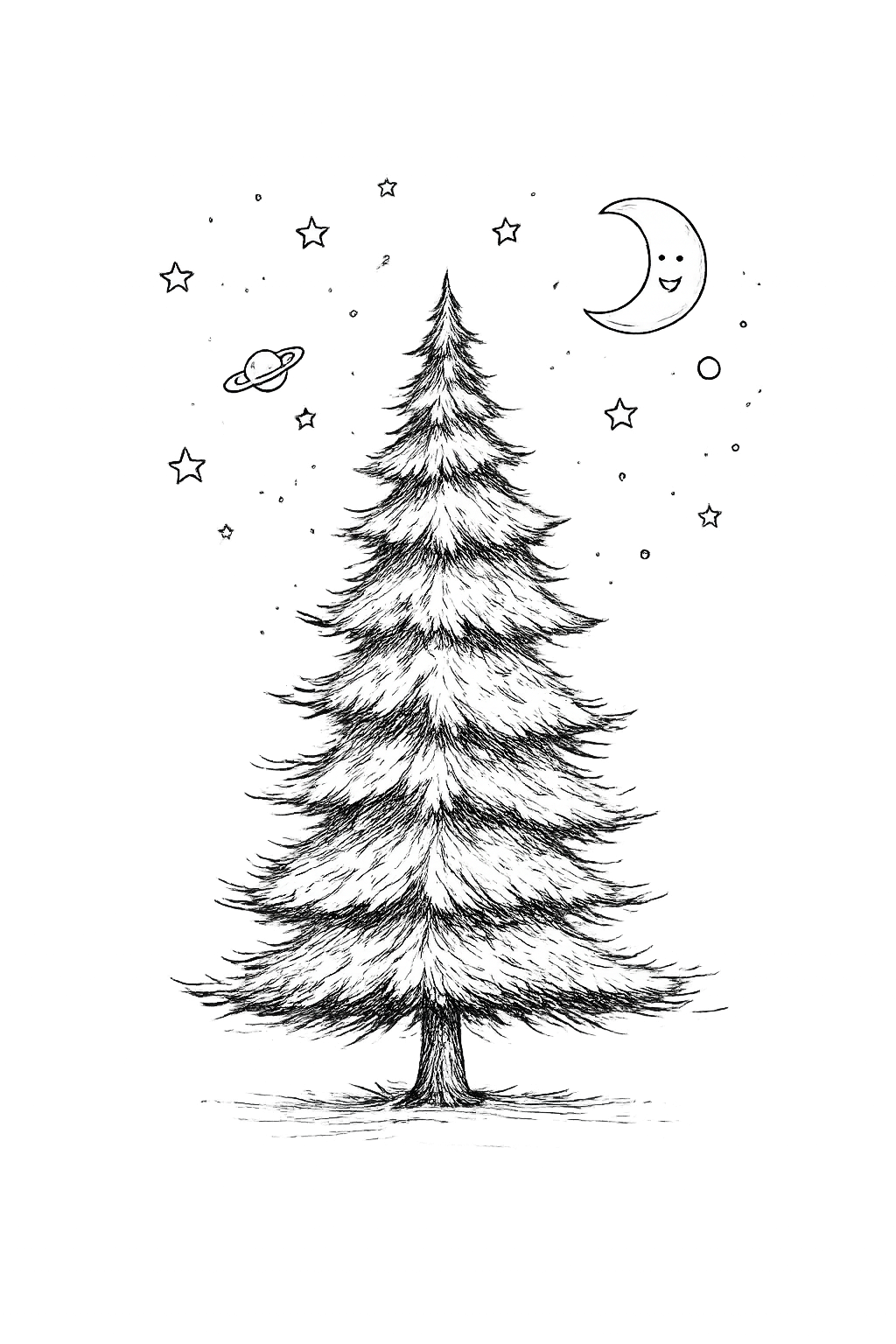
The moon appears in my drawings during daylight because visibility and existence have never been the same thing. The stars are not absent. The sky is merely too loud to notice them. Pine trees have never asked me to explain myself before offering shade. A forest does not care what name was written on the paperwork.
The moon has spent eternity being misunderstood by people who believe absence and invisibility mean the same thing. She does not need recognition in order to remain real. She does not become absent simply because the conditions make her difficult to see. Neither did I. Being excluded from the continuing story did not mean I had never been central to it. Being forgotten by some people did not mean I had never mattered. The end of love does not retroactively mean it never existed.
I spent much of my life treating permanence as the only reliable indication that something had been real. If someone stayed, perhaps I had been loved. If someone left, perhaps I had misunderstood the entire relationship. People can love us and leave. People can fail us and still have loved us.
Reality is rarely organized well enough to fit inside a bubble filled in according to the instructions with a No. 2 pencil.
What has that fear taught me about love, memory, and the parts of myself that survived despite it?
It taught me that love is not proven by permanence alone. Memory preserves atmosphere as much as fact. I remember who I became around certain people. I remember how my body felt when I was not waiting for punishment. I remember the feeling of being included. I remember the relief of being called Emily without an explanation attached.
My fear of abandonment remains. I do not expect it to disappear simply because I understand where it came from. I know now that being left is not the same thing as never having been loved. I know that being excluded from the current version of a story does not remove me from the parts in which I mattered. I know that some people remembered me, some forgot, some misunderstood, some chose easier explanations, and some arrived in a blue station wagon because their daughter needed them.
The car eventually stopped being the center point of my life. Mom got sick and eventually stopped driving herself around. Camp continued without me. Everyone continued without me somewhere. I continued, too.
That is the part abandonment never predicts correctly. It assumes every departure will remove the world itself. Instead, the world changes. Other people answer the phone. New places to belong become possible. Pine trees still offer shade without asking questions. The moon appears before the sky is ready for her.
And somewhere inside every version of my life, the same girl is still filling in the correct bubble.
|
Copyright © 1998-2026 Emily Pratt Slatin. All Rights Reserved. About | Archives | Biography | EMD Codes | Notebook | Press Kit | Pronouns.page | RSS Feed | Sitemap | YouTube Made with grit in Middletown Springs, Vermont. |