
She/Her/Hers
Lesbian
|
|
EMILY PRATT SLATIN | About | Press Kit | Notebook | Music Playlist | She/Her/Hers Lesbian |
Retired Career Fire and EMS Lieutenant-Specialist, Writer, and Master Photographer, living in Vermont.
May 23, 2026—Middletown Springs, Vermont (Home)
Today I kept thinking about the little universe I keep drawing over everything—the daytime moon, the stars, Saturn, all of them fully visible when they technically should not be. I have been asking myself what that means, and maybe the answer is simpler than I thought. They are visible because they never stopped being there.
The stars do not vanish in daylight. We simply lose the ability to see them.
That feels like most of my life, really. The important things have always been present beneath whatever was happening on the surface: history, machinery, memory, grief, absurdity, repair, intelligence, public duty, and the quiet systems that keep everything from falling apart. My drawings do not erase those things just because the official light of day says they should be invisible. In my drawings, the sky tells the truth. The moon is still there. Saturn is still there. The stars are still there. The past is still there. The people I loved are still there. The machines are still humming somewhere behind the wall.
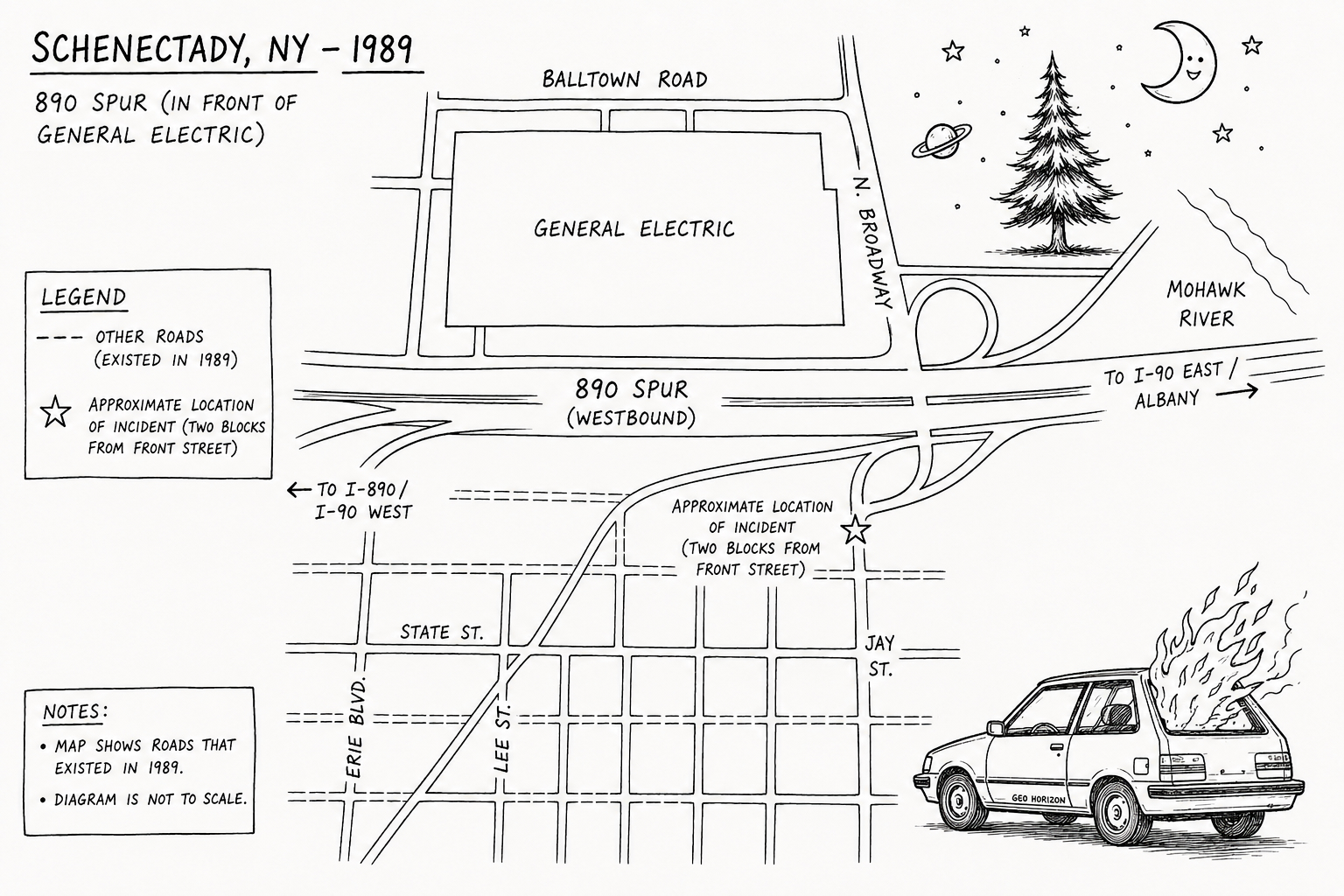
I showed Amelia the drawing today—the Geo Horizon fire drawing, the one with the roads that existed in 1989, General Electric, the little burning car, the moon, Saturn, the pine tree, and the absurd calm of a diagram pretending to be objective. The more I talked through the actual story, the funnier it became. Not funny in the cheap way. Funny in the true way. The kind of funny that only reality can manage because fiction would be accused of overdoing it.
Dad and Arturo. His name was Arthur Sterling Covert. Arturo to us. Dad's best friend from the Manhattan Project. A statistician. A GE scientist after the war. Worth millions, apparently, but living as cheaply as any old Schenectady practical genius with attic carpet remnants and a total moral refusal to throw anything away if it could still be made useful.
Arturo drove a white Geo Horizon. The car began with an interior so aggressively red that it practically attacked you when you opened the door. Not a tasteful red, not a dignified burgundy, but that horrifying late-eighties economy-car red that looked like it had been chosen by someone who believed upholstery should have the visual force of a warning flare. Then came the brakes. Or rather, the absence of brakes.
Dad or Arturo trusted American engineering to still hold, despite being so worn out and past any logical expectation of tolerances that the engineers would have quit their jobs and sought divinity had they found out.
And because this was Dad and Arturo, the absence of brakes did not mean the absence of a plan.
The plan, apparently, was to drive the car anyway and coast it to a stop at the destination. They had planned to go out for lunch at Fo'Castle Farm, which was Arturo's tradition every Saturday, and he was not about to miss his routine.
We drove in Arturo's car even though my fathers car, which was in perfect working order, aside from broken door locks, was parked directly ahead of the Geo.
This is the kind of sentence that explains an entire generation of men. They did not see a failed brake system or a muffler half hanging off. They saw a solvable sequencing problem involving terrain, timing, velocity, and confidence. The fact that both of these men had worked on the Manhattan Project somehow makes the story funnier rather than less plausible. High intelligence does not always prevent bad decisions. Sometimes it simply allows the bad decision to arrive with calculations.
We took the Geo anyway. Arturo had somehow managed to get us all the way to Fo'Castle Farm, and by the time we arrived, all you could hear was the high-pitched metallic grinding noise coming from somewhere deep beneath the car, the sound sharp enough that it seemed less mechanical than surgical. We finally came to a stop when Arturo turned into the hill by the apple orchard, using the incline itself as part of the braking strategy.
For one brief moment, it appeared the plan had worked. Then the Geo began slowly rolling backwards. Arturo yanked up on the emergency brake with complete confidence and the cable snapped immediately. Dad climbed out without saying a word, found a rock near the edge of the orchard, and wedged it behind the rear tire as though this was a perfectly normal continuation of the afternoon.
We had our usual lunch at the café afterward as though nothing particularly unusual had happened. Arturo ordered soup, but declined a beverage entirely. His reasoning was that he already had something to drink—he simply needed to wait long enough for the broth at the bottom of the bowl to cool. This logic made perfect sense to him, and therefore, by extension, to everyone else at the table. I had my usual peanut butter and strawberry preserves on white Wonder Bread, which Fo'Castle Farm somehow managed to make feel less like a children's lunch and more like part of an established ritual. Outside, somewhere beyond the windows, the Geo Horizon sat quietly in the parking lot with a rock behind the rear tire to prevent it from rolling backwards down the hill and into the other parked cars.
This was a very popular place during my childhood, and the parking lot, which was dirt and gravel at the time, filled up quickly every weekend. Parking a car there—or attempting to leave afterward—became an exercise in applied geometry because there was no pavement, no painted lines, and no real grid layout of any kind. Cars were arranged organically according to driver confidence, available space, and whatever interpretation of angles people arrived with that particular afternoon.
Dad and Arturo decided to wait until most of the other cars had left before attempting to extract the Geo from the increasingly impossible arrangement of station wagons, pickup trucks, and aging sedans surrounding it. The parking lot smelled of rust, gasoline, and the last warm air of September.
Once the lot had mostly cleared, they took turns putting the car in neutral, turning the wheel, and pushing it by hand through the gravel while discussing the operation with the seriousness of men repositioning heavy industrial equipment. I was ten years old at the time and tried very hard not to feel embarrassed by any of it by deciding that this was probably normal adult male behavior, especially among scientists.
Dad and Arturo stood beside the Geo in the gravel parking lot and carefully discussed the route back to Arturo's house on Front Street in Schenectady, eventually selecting one with the fewest stop signs, traffic lights, hills, and intersections. Their planning carried the tone of men preparing a lunar landing rather than returning home in a compact hatchback with no functional brakes and an emergency brake cable that had already snapped earlier in the afternoon.
Any other reasonably functional individuals would have gone back inside, ordered dessert from the café, and waited for a tow truck to arrive. Dad and Arturo instead approached the problem as a navigational exercise involving momentum preservation, terrain management, and confidence in aging American machinery operating well beyond its intended tolerances. To them, this was not evidence that the day had gone wrong. It was simply the next phase of the operation.
On the way home, the car then hit a series of railroad crossings at too much speed, and the muffler fell off. It took the entire exhaust system pipes with it, which got run over by one of the back tires upon its untimely departure.
We drove past the GE plant where a police officer had been sitting in his patrol car on what had otherwise been a completely uneventful Saturday afternoon. When the white Geo Horizon went by trailing smoke from somewhere underneath the chassis like a small industrial accident attempting to maintain highway speed, it caught his attention immediately.
At that moment, Arturo expressed concern to my father about the possibility of the police officer initiating a traffic stop for the loud exhaust.
I still remember him slowly pulling out behind us with the cautious curiosity of a man who was not yet certain whether he was witnessing a mechanical failure, a fire, or some entirely new category of problem. Dad and Arturo, meanwhile, continued toward downtown Schenectady with complete composure, as though driving a smoking, brakeless Geo Horizon through city traffic was merely an unconventional transportation strategy rather than the beginning of a police report nobody would later believe.
And then suddenly when we managed to coast to a stop at an unexpected red light two blocks from Front Street, the Geo Horizon caught fire. The police officer pulled over behind us, and brought over a fire extinguisher that failed to function. My father decided that the best course of action was to get out of the car and start flailing his arms back and forth above his head like a machine in an attempt to get the attention, and ideally, the assistance of another passing motorist.
The only person who stopped was a taxi driver who happened to have a spare fire extinguisher in the trunk of his yellow nineteen eighties sedan. Only the back seat cushion burned, which meant, to Arturo, that the car was not dead. It had merely suffered a localized thermal inconvenience.
The police officer, who by this point had become less of a law enforcement presence and more of an unwilling participant in the unfolding situation, kindly offered assistance and suggested that he could radio dispatch and have a tow truck there immediately. Any sane person standing beside a recently burning, brakeless Geo Horizon in downtown Schenectady would likely have accepted this offer without hesitation.
Dad instead decided that the better plan was to pay the taxi driver to take Arturo back to his house on Front Street so he could retrieve the keys to my father's brown Nissan Sentra, return with it, and then tow the Geo the remaining short distance home themselves. The police officer stood there listening to this proposed solution with the expression of a man slowly realizing that he was no longer dealing with ordinary mechanical failure, but with two elderly scientists treating catastrophe as a collaborative engineering exercise.
The officer reluctantly allowed it. Arturo went back to his house via taxi, and had returned minutes later with my fathers car to tow Arturo's wounded Geo Horizon back. Unfortunately because apparently no tow strap, rope, chain, or proper vehicle recovery equipment was available. My father instead used clothesline, which worked until it didn't.
The police officer began openly questioning the plan once he saw my father outside threading the same continuous length of cotton rope around both cars' bumpers with the confidence of a man preparing marine rigging rather than roadside vehicle recovery.
Dad looked up at him and said, "I'm Harvey Slatin, one of the scientists from the Manhattan Project. My army buddy and I built the atom bomb."
The officer paused for a moment, holding back the kind of sarcastic smile unique to upstate New York police officers who have already decided reality has become unreliable, then replied, "Oh yeah? And my next-door neighbor is George Washington."
He then walked around to the side of the car where I was standing and lowered his voice slightly. "Hey young lady," he said, "I hope you have normal parents because your grandfather is nuts."
Without missing a beat, my father shouted in a voice loud enough to echo off the nearby buildings, "That's my son, idiot." The officer looked briefly stunned by the correction, then asked me quietly if I was safe. I told him yes.
The Schenectady police officer followed the procession all the way back toward Front Street. Dad drove his brown Nissan Sentra slowly through the city streets while the officer trailed behind with the roof lights flashing, less like an active police escort and more like a man who had committed himself to witnessing the ending of a situation he no longer fully understood.
For the short distance involved, the rope actually held remarkably well. The problem came when my father had to make a sharp ninety-degree left turn onto Front Street with the manual shift Sentra. As the cars pivoted through the intersection, the knot on one side partially failed, but instead of separating completely, the rope remained wrapped around the bumper supports of both cars and began slowly unraveling itself under tension.
By this point the cotton rope had stretched enough that it behaved less like a tow line and more like an enormous elastic band storing kinetic energy. Dad, meanwhile, had spotted Arturo's house and became overconfident at the exact wrong moment, giving the Sentra too much gas in celebration of visual confirmation that the mission was nearly complete.
The rope snapped a second later. Dad never noticed Arturo was no longer behind him. Arturo had been attempting to warn him by sounding the horn, but the battery had been removed earlier because of the fire, so the horn no longer functioned. There were also still no brakes, and the emergency brake cable had snapped that afternoon in the Fo'Castle Farm parking lot.
Arturo attempted to coast the Geo under control, then tried running the sidewalls of the tires into the curb to create friction, but even that failed because the original slate curbs along Front Street were too smooth and unforgiving to slow the car meaningfully. A few seconds after Dad parked the Sentra and climbed out, convinced the operation had been a success, the Geo Horizon came silently rolling down the street and crashed directly into the back of his car while the police officer and I watched the entire thing happen in complete disbelief.
For safety reasons, the officer had let me ride in the front seat of his cruiser, and asked me to confirm that I was my mothers daughter. After deciding that I was safe and the car situation had been resolved, he briefly stated that unless it was needed for insurance, he was not going to write a report because nobody would believe it.
And the best part is that Arturo kept the car. He found an identical Geo Horizon in a junkyard, replaced the burned back seat, and covered the scorched carpet with baby blue shag carpet remnants he had in his attic from his house.
There is something so beautifully American about that. A millionaire statistician, a Manhattan Project veteran, a GE man, repairing a partially fire-damaged economy hatchback with junkyard parts and domestic shag carpet remnant because the car was still, in his mind, a viable automobile.
It makes perfect sense to me. That generation did not always separate thrift from ethics, or repair from identity. If something could still work, discarding it was almost vulgar. Waste was failure. Repair was proof of mind. And if the repair did not match, well, that was a cosmetic matter and not worth losing sleep over.
I think about Arturo living on Front Street in Schenectady, moving through the world cheaply despite having money, known by the GE front gate guard, trusted enough that he could bring Dad and me through because he was assumed to have a good reason. I was a small child, but I was brought into places most children never saw. GE. Labs. Work areas. Things adults would not explain because they could not or would not tell me what they were doing. I saw rooms, machines, benches, men, instruments, processes, and mysteries. I did not know what all of it meant, but I understood that the world had layers.
That was one of the great educations of my life: being allowed to experience the layers that made modern life possible.
Dad took me to Fidelity Chemical in New Jersey sometimes when I had a day off from school. His boss was not pleased, but Dad brought me anyway. Chemistry was happening around me, and I did not understand it at the time. But I understood tone. I understood seriousness. I understood that adults could work on invisible forces and material transformations, and that the visible world was only the top surface of the actual world. Dad had a PhD in atomic engineering. Arturo was trained as a statistician. Their minds were built around what could not always be seen directly: probabilities, reactions, particles, forces, systems, failures, tolerances, and consequences.
Then there was the Gilboa-Conesville hydroelectric project. Somehow Dad secured a tour of the plant for me when I was a child. I remember the hard hat, and I remember the foremen ratcheting it down all the way to fit my small head.
I loved that plant. Absolutely fascinating place. Water, pressure, concrete, turbines, control, mass, vibration, all at massive scale. It was not a museum version of reality. It was the actual machinery. I got to stand inside the kind of system most people only benefit from invisibly.
Then, years later, I returned there as a lieutenant because there was an accident, and I happened to be on call. That still feels strange. The first time, I was a little girl in a hard hat that had to be ratcheted down by foremen. The second time, I was the lieutenant in charge who was responding to an emergency. Same place, different self. The child who stared in wonder and the woman responsible for command met each other there, whether anyone else knew it or not.
Maybe places remember us. Or maybe we remember ourselves more clearly when we return to the places that formed us.
Mom gave me another version of that same gift when she became mayor. She made it a point to say that Emily needed to experience municipal infrastructure as part of her ongoing job training. I loved her for that.
Because of Mom, I got to see the actual backside of municipal life: highway crews, water systems, sewer plants, operations, maintenance, the people who kept civilization functioning while everyone else complained about taxes and potholes. She did not just show me politics. She showed me the work underneath politics. The pumps, the roads, the pipes, the trucks, the crews, the calls, the repairs, the weather, the failures, the absurdities that came with it, along with the constant need to keep going.
That became part of me.
It is probably why I loved SimCity as a child. Once I had the city established, I could pivot into maintaining the public safety aspect. Other kids may have wanted skyscrapers, disasters, money, or control. I wanted happiness. I wanted the city to work. I wanted a lot of schools, hospitals, and fire stations placed properly, police coverage maintained, capacity preserved, and the public kept safe and happy. The city was not a toy to dominate. It was a system to care for.
That is still how I think. At one meeting, I held up a press photo of city hall and said, "I think I've determined the problem."
I was not wrong. Our funding was cut or frozen each fiscal year of my career where I worked, and it was always a constant struggle to keep things effective. There is a particular exhaustion that comes from trying to keep a public safety system functional while the people controlling the money treat prevention as optional. They do not always understand that a dollar invested in education, health, public safety, housing stability, treatment, infrastructure, or basic human needs often prevents an equal or greater expense later.
They cut the maintenance, then act surprised by the collapse. They cut prevention, then ask why response costs more. They cut the financial backing, then expect those who worked for the municipality to absorb the consequences downstream with less money, fewer people, and increasing demand.
Civilization is not maintained by speeches or promises. It is maintained by people who show up with tools, maps, radios, clipboards, wrenches, lab notebooks, and sometimes clothesline.
|
Copyright © 1998-2026 Emily Pratt Slatin. All Rights Reserved. About | Archives | Biography | EMD Codes | Notebook | Press Kit | Pronouns.page | RSS Feed | Sitemap | YouTube Made with grit in Middletown Springs, Vermont. |