
She/Her/Hers
Lesbian
|
|
EMILY PRATT SLATIN | About | Press Kit | Notebook | Music Playlist | She/Her/Hers Lesbian |
Retired Career Fire and EMS Lieutenant-Specialist, Writer, and Master Photographer, living in Vermont.
October 7, 2026—Middletown Springs, Vermont (Home)
I spent a total of twenty-two consecutive days at Mom’s house. This hasn’t happened since 1993.
I arrived home at the farm at eight o'clock this evening after spending the past few days with Angie at Mom's house in Stamford, New York. Last night, Angie and I went back to Denny's in Oneonta for dinner.
The Denny's in Oneonta has been my favorite since December of 1997. We sat there talking about the people who had been part of our lives over the years, most of whom have either gone their separate ways or died of old age. I found myself wondering where the hell all those years went.
It seems like yesterday that we were kids doing whatever we could to get by, and now we're middle-aged women sitting in a Denny's. I have never been particularly good at accepting the passage of time.
It was Christmas 1997 when my cousin James and my best friend, Matthew Jacob Orlando, were staying at Mom's house for the holidays. Matt and I had recently uncovered a baby blue Ford Fairlane in his parents' barn on Wilcox Road in Harpersfield, New York. We decided to get the car running and make it road legal, which seemed like a perfectly reasonable undertaking for two eighteen-year-olds. We repaired enough of the car to get it running, installed new carpeting, and prepared to have it inspected. There was only one minor complication.
The car had no floorboards. None. The carpeting was essentially the only thing separating our feet from the road beneath us, but the car ran. One morning, James, Matt, and I decided to drive the Fairlane to Denny's in Oneonta for breakfast.
We made the trip through the back roads of Harpersfield where we re-joined NY-23 before passing through Davenport. We had our coffee, ate breakfast, and returned to Stamford to have the car inspected. Unfortunately, the mechanic stepped into the driver's seat, put his foot through the carpeting, and discovered that his right foot was touching the ground beneath the car. He informed us that New York State would not permit him to certify a vehicle that lacked front floorboards. Apparently, this was considered a significant safety concern that might reasonably also be considered common sense enough that it didn’t need to be mentioned on the inspection report.
Matt and I needed a solution, and neither of us was particularly interested in spending money on replacement floorboards. At approximately four o'clock the following morning, we drove out to the most remote parts of Harpersfield and stole two steel stop signs. We brought them back to his parents’ barn, welded them into the floor of the Fairlane, and put the carpeting back over them.
The following day, we returned to the same mechanic, who wanted to verify that we had repaired the floor. He pulled back the carpeting and found himself staring at the word STOP in enormous white letters against an alarming red background.
He looked at us and said, "You two idiots expect me to certify this vehicle as safe based on the fact that you stole two stop signs and welded them in???”
Matt and I nodded with an unprecedented amount of enthusiasm. The mechanic considered the situation for a moment before announcing, "$10 for the inspection fee, and a six-pack of beer.”
Matt purchased the beer in cash from a local shopkeeper who never checked identification, the mechanic put an inspection sticker on the windshield, and the Fairlane was officially road legal.
I have no idea how any of us survived our adolescence.
Matt and I had been friends since 1986. He was the first person I trusted enough to tell that I was genetically female, that my birth certificate documented it, and that I was absolutely a lesbian. This was long before my father began imposing nondisclosure agreements and attempting to dictate what other people were permitted to know about me.
He listened to what I told him and responded with something he would repeat throughout our friendship: "In life you is who you is.”
That was Matt. Whenever I questioned myself, he reminded me of those words and pointed out that we had been friends since 1986, as though the length of our friendship should have been sufficient evidence that I had nothing to worry about.
He didn't require an explanation. He just knew me.
In early 2002, several months after the September 11 attacks, Angie and I moved to Long Island. I had accepted a position with a private ambulance company in the New York City metropolitan area, where I would frequently interface directly with FDNY.
Before leaving Stamford, I met Matt at the corner of Academy and Main Street to say goodbye. The old hotel that had stood on that corner burned to the ground in 1998, and my parents subsequently purchased the property. Mom allowed me to plant my very own pine tree alongside the one that had stood outside my bedroom window for as long as I could remember.
I told Matt that I had to go to New York City for work, that I would be back when my contract ended, and that we'd pick up where we left off. I gave him all my contact information, said goodbye, and left. I've searched for him ever since. I don't know where he went or what happened to him.
Every time I cross Academy and Main Street and pass that particular spot on the sidewalk, I envision Matt still standing there waiting for my return, as though he has remained frozen in the exact space and time where I last saw him.
The paramedic job in New York City changed me in ways that I hope one day I will be able to comprehend. I spent twenty-two years in fire and emergency medical services, and I saw everything. The good, the bad, and everything in between. I witnessed things that fundamentally changed my understanding of religion, morality, human behavior, and what it means to be human.
There are experiences from that career that I still cannot adequately explain, even to myself. I know what happened, I know what I saw, and I know the decisions I made, yet I don't always understand how those experiences actually affected me.
Matt knew me before all of that. He knew the girl who was eighteen years old, who still believed that most of life's problems could be solved with sufficient determination and a questionable amount of mechanical ingenuity.
I miss him.
I've always had an unusual relationship with continuity. I can go decades without seeing someone and resume our friendship as though we'd spoken yesterday. My friends have generally accepted this about me, while my family thought it was strange.
When I eventually saw my cousins again after many years, following my uncle Bob's death, Mom, Angie, and I had traveled to Lockport to visit my aunt Holly, who had been diagnosed with late-stage Alzheimer's disease. My maternal grandmother and my Aunt Holly were both alcoholics, and my family history was complicated long before I was old enough to understand most of it.
By the time I saw my cousins again, so much time had passed that the memories of our childhood seemed insignificant. They may have been insignificant to everyone else, but they weren't insignificant to me. I have always needed to maintain some degree of continuity between the different periods of my life. I don't believe that the passage of time automatically invalidates a friendship or makes the experiences we shared less important. When I see someone after twenty years, I don't necessarily want to begin an entirely new relationship. I want to continue the one we already had.
Angie understands this better than most people. We've known each other since I was twelve years old. She attended Jefferson Central School, in the next town over, and our paths crossed numerous times throughout our childhood and adolescence.
We were casual friends, then close friends, and eventually began dating. She moved in almost immediately. We spent twenty years together before I left her in 2020. At the time, I was dealing with health problems, the end of my career, and an insatiable desire to leave New York permanently.
I got into my car, drove away, and never returned. I have mixed feelings about that decision, and I feel bad about leaving her. I still care about Angie. Of course I do. She was an enormous part of my life, and at one time or another she occupied practically every social relationship classification available to two people.
We were never married, but we shared twenty years of adulthood, countless family gatherings, friendships, holidays, and experiences that neither of us can simply erase. When I'm with Angie today, it still feels like being with one of the longest-running, closest relationships of my life. Whatever happened between us in 2020 didn't suddenly make the preceding decades disappear.
Today, Angie told me about one of her earliest memories of me. One summer, I attended a two-week youth soccer program at Minekill State Park, where Angie was working as a lifeguard and at the snack bar. Apparently, I flirted with her wildly.
She remembered telling her friends, "I'm being flirted with by a kid." The irony is that we eventually spent twenty years together. Angie is exactly three years, seven months, and fourteen days older than me. Everyone I dated was within four years of my age, with the exception of Amelia, who is exactly seven years, nine months, and eighteen days younger than me.
Angie's parents were Robert and Tina Conklin of Jefferson, New York. Her younger sister, Carrie, and the rest of the family accepted me as one of their own from the beginning, despite the fact that Angie and I never married. Angie had an older sister named Helen who was a part of my life during my relationship with Angie, but only during sporadic stretches of time.
Carrie and I had an interesting relationship. She liked to argue with me, and I frequently questioned my place within the family, although she never actually denied that I belonged there.
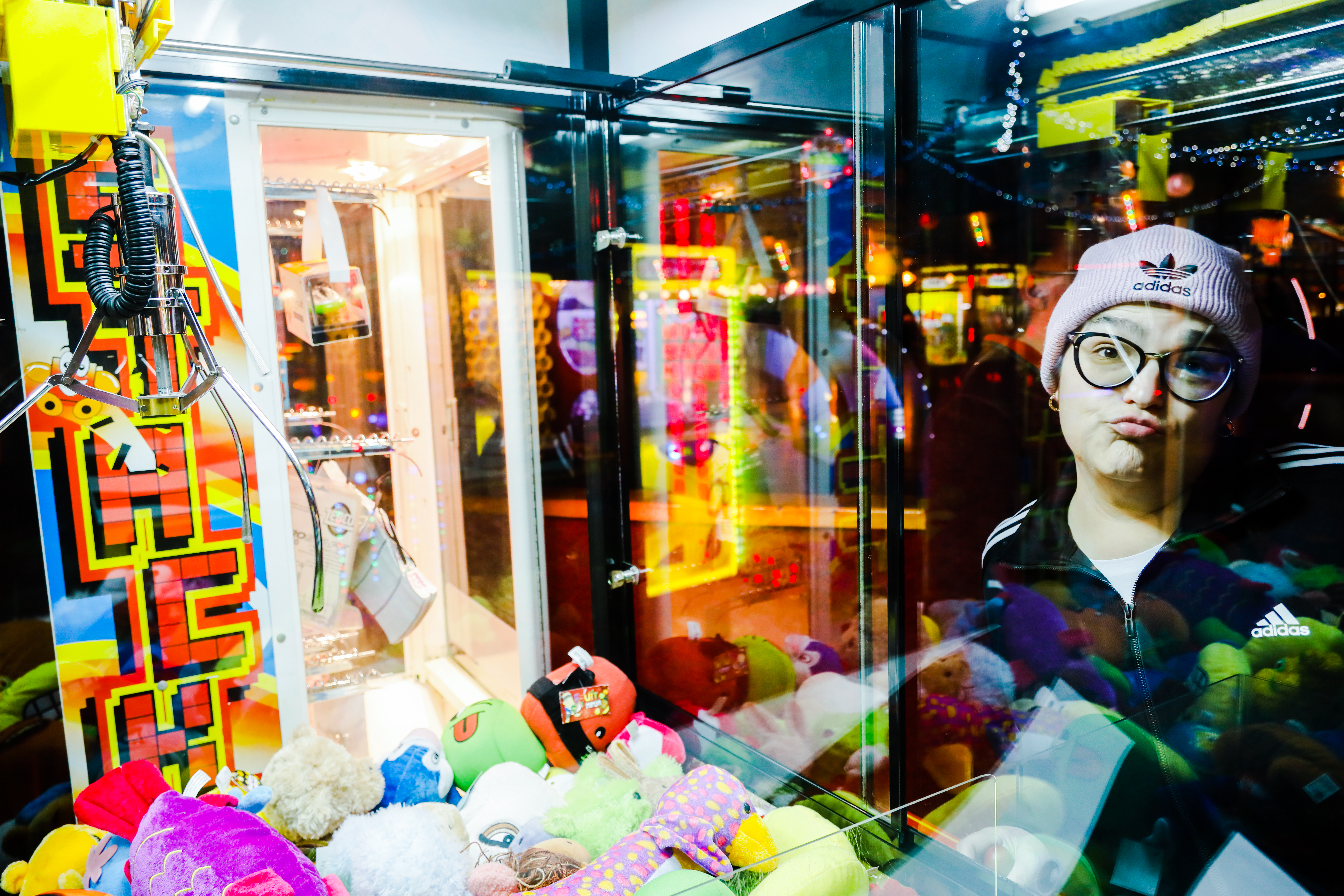
Carrie regularly organized family outings, including birthday celebrations at Interskate 88 in Oneonta. In February 2018, we were there celebrating her daughter Makayla's birthday, and I photographed Angie making a ridiculous face beside a claw machine.
I still have that photograph. It was an ordinary family outing, the sort of thing nobody considers particularly important while it's happening. After I left Angie in 2020, Carrie was upset, and with the exception of her mother, Tina and her cousin, Chris Taylor, I haven't spoken to the rest of the family since.
My mother despised Angie, and I never understood why. My father, meanwhile, had required Angie to sign a nondisclosure agreement stipulating that I was to be referred to exclusively as male, using the name he had assigned to me, and that my intersex condition could never be disclosed except to a medical provider.
The condition itself was described using its lengthy medical terminology, apparently because making something sound sufficiently complicated was preferable to acknowledging the obvious.
Angie signed the agreement because she trusted my father completely. I couldn't speak openly with her about my intersex condition until after he died.
Today, I told Angie that my entire life, I have identified as a female who happened to have what looks like a penis. That's how I've always understood myself. I wasn't confused about being female, although other people certainly seemed determined to be confused on my behalf. Angie told me that she had always known something didn't line up, and that her father had expressed similar feelings.
According to Angie, both of them would have accepted me regardless. I wish someone had told me that with certainty all those years ago. It would have eliminated some of the anxiety I carried for years, although it wouldn't have changed the restrictions my father imposed upon what I could say. Angie’s late father, Robert Conklin, was a good man to me, and I wish I'd had the opportunity to discuss it with him directly.
Yesterday evening at Denny's, Angie and I also remembered the Thanksgiving Hot Glue Incident, which happened at her parents' house during the final years of her father’s life.
We spent practically the entire day today talking about it, reconstructing the events in detail, and laughing about something that probably should have resulted in a complete reassessment of Chris' qualifications to repair household furniture.
The morning began with me driving through the village of Cobleskill, New York, carrying a turkey to Thanksgiving dinner. I was traveling seventy-four miles per hour in a thirty-mile-per-hour zone when I passed a New York State Trooper. Naturally, he pulled me over.
He recognized me and said, “Lieutenant; are you responding to a fire call?”
I explained that I was transporting a turkey to Thanksgiving dinner at my in-laws. He immediately let me go. I successfully delivered the turkey to Angie's parents' house.
As everyone began sitting down for Thanksgiving dinner, one of the dining-room chairs collapsed. Then another chair collapsed. Then another. People were falling to the floor one at a time, and it eventually became apparent that Chris had repaired the chairs with hot glue.
I jokingly asked him, "What else in this house did you hot glue recently?”
It turned out that he had repaired all of the chairs. Unfortunately, he had also used hot glue to repair the supports underneath the dining-room table. By this point, the entire Thanksgiving dinner was sitting on the table, including two turkeys, a ham, desserts, and all the traditional sides that had been prepared.
Then suddenly without warning, one end of the table failed, leaving the entire table at approximately a forty-five-degree incline. The food began sliding toward the lower end of the table, and within moments, the entire Thanksgiving dinner sailed directly into the kitchen stove, the ceramic bowls breaking when they hit the floor.
Tina screamed, "Chris, I'm going to kill you.”
I looked at everyone and said, "Happy Thanksgiving, everyone.”
Angie’s father started laughing and couldn't stop for several minutes. The food was beyond recovery, and we eventually found ourselves cleaning Thanksgiving dinner off the floor with brooms and a dustpan. Everyone pooled their cash, and we went to Ming Moon in Stamford for Chinese food.
My Mom had been promised a plate of Thanksgiving dinner from Angie's parents, and practically everything had been destroyed. The only food that survived was four slices of spiral ham that had already been sitting on top of the stove rather than on the collapsing table. Mom got the four slices of ham in a plastic bag. I suppose that was better than nothing, although I doubt it was the Thanksgiving dinner she had anticipated. To this day, I cannot think about that incident without remembering the remains of an entire holiday meal lay scattered across the kitchen floor.
Angie and I spent hours today remembering every detail. It was one of those experiences that became considerably funnier with the passage of time.
By the time I left Stamford and drove home to Vermont this evening, I had been thinking about considerably more than Denny's, Thanksgiving, or the people Angie and I used to know.
I realized that throughout my life, I've consistently failed to follow what other people told me to do. I've spent much of my life feeling out of place, and I've always been a little different. I'm not entirely certain whether that's because of my autism, my intersex condition, the hardships I experienced growing up, or some combination of everything.
My childhood was difficult, and I spent years trying to understand why I seemed to have such a different relationship with the world than the people around me. Teachers complained about me, my parents wanted me to behave differently, and my father seemed determined to make me into someone I had never been.
I questioned instructions that didn't make sense, refused to accept explanations that contradicted what I knew, and frequently found myself at odds with people who believed that obedience was more important than understanding. Looking back, I don't think I was particularly interested in being difficult. I wanted things to make sense, and when they didn't, I wanted to know why.
My career changed that outlook in ways I still struggle to understand. I spent twenty-two years in fire and emergency medical services, eventually retiring as a Lieutenant-Specialist, and during that time I witnessed enough of humanity to permanently change my understanding of what it means to be alive.
I saw people at their absolute best and their absolute worst. I witnessed extraordinary acts of kindness, cruelty, courage, desperation, and indifference. I saw things that made me question religion, morality, and the assumptions I'd carried since childhood. Some of those experiences reinforced what I already believed, while others made it impossible to continue believing certain things at all.
There are questions I have about humanity that I don't expect to answer in my lifetime, and there are things I witnessed that I still think about years after leaving the job. I know that the work changed me, but I don't think I've fully comprehended the extent of those changes. I spent so much of my adult life responding to emergencies, making decisions under circumstances that most people will never experience, and witnessing the consequences of things that couldn't be undone.
Eventually, the experiences accumulated into something that fundamentally changed my understanding of life, death, religion, and what it means to be human.
I don't necessarily believe that everything happens for a reason, nor do I believe that suffering automatically makes someone stronger or wiser. Sometimes terrible things happen, and there isn't a satisfactory explanation. Sometimes people do extraordinary things for complete strangers, and sometimes they do things that I still cannot reconcile with any reasonable understanding of human behavior. I've seen enough of both to know that humanity is considerably more complicated than I once believed.
Over the past two days, Angie and I had talked about nearly thirty years of memories.
Today, I told Angie that I don't want to die regretting the things I wanted to see or experience but never did. I've spent enough time around death, destruction, and catastrophe to understand that there is never a guarantee of another opportunity, another year, or another convenient time to do something.
I want to travel, take photographs, write, meet people, visit places I've never been, and do the things I've spent years thinking about doing. I don't particularly care whether other people understand why those experiences matter to me.
I've spent most of my life being told what I should do. At forty-seven, I have considerably less interest in allowing other people's expectations to dictate how I spend whatever time I have left.
|
Copyright © 1998-2026 Emily Pratt Slatin. All Rights Reserved. About | Archives | Biography | EMD Codes | Notebook | Press Kit | Pronouns.page | RSS Feed | Sitemap | YouTube Made with grit in Middletown Springs, Vermont. |